
The Complete Guide to Earned Media Value: 5 Formulas Every Brand Should Know
Earned Media Value (EMV) puts a dollar figure on unpaid brand exposure, from word of mouth to influencer mentions. This guide covers the five formulas in use today, when each applies, and where the metric reaches its limits.

Every brand mention nobody paid for still has a price. A customer who posts about your product, an employee who reshares a company update, a journalist who quotes your founder without a media buy behind it: all of it created reach, and all of it can be priced. That is the purpose of Earned Media Value.
Quick answer: Earned Media Value (EMV) is a metric that assigns a monetary figure to unpaid brand exposure, including word of mouth, social shares, employee advocacy, influencer mentions, and user generated content. It estimates what a brand would have had to spend on paid advertising to reach the same audience with the same level of engagement.
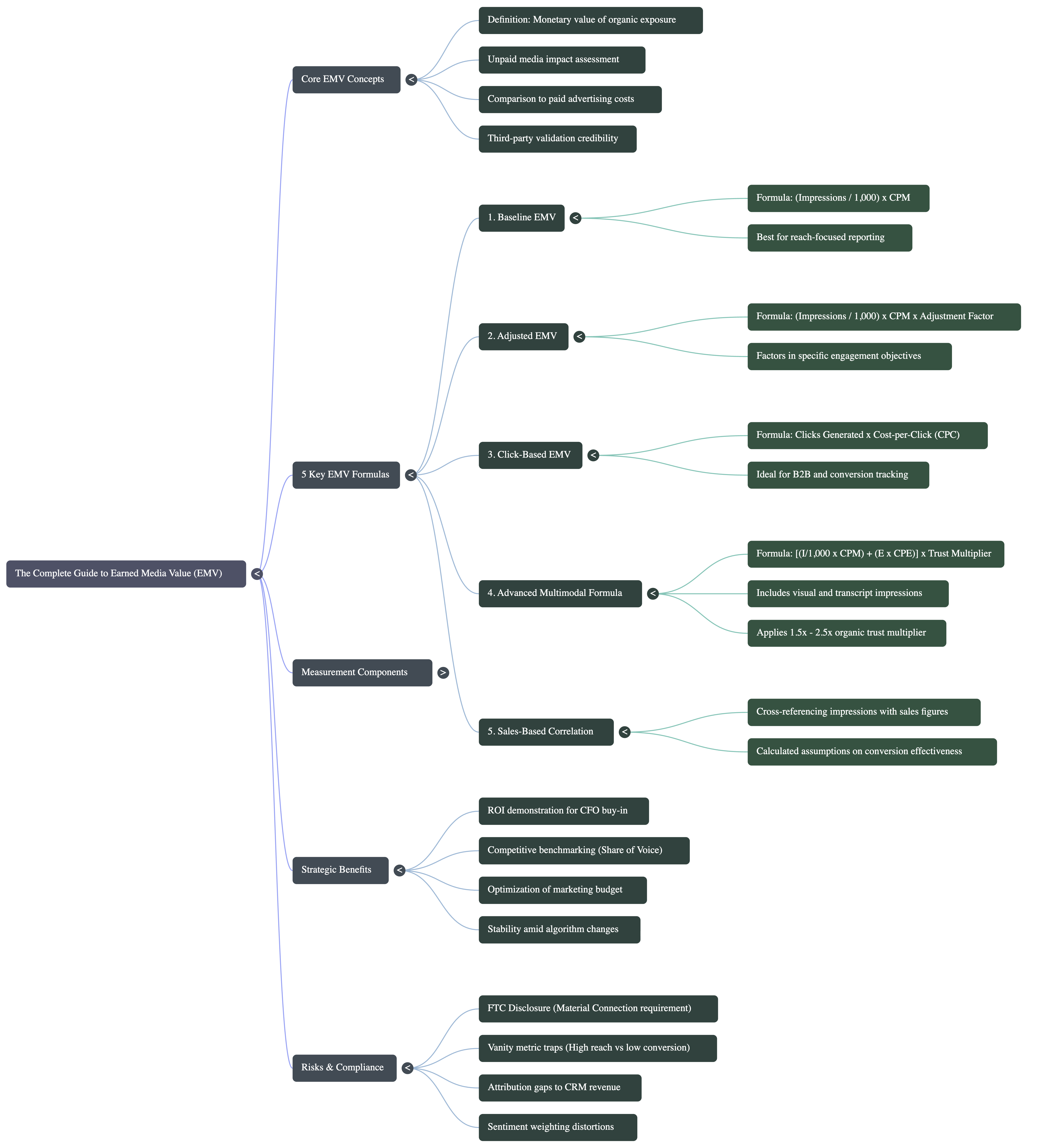
A concept map of the ideas covered in this guide: core EMV concepts, the five formulas, and where the metric carries risk.
There is no single industry standard for calculating EMV. The right formula depends on whether a campaign is judged on reach, clicks, engagement quality, or video performance. This guide covers the five formulas currently in use, when each one applies, and where the metric reaches its limits.
What Earned Media Value Actually Measures
EMV does not measure sentiment, and it does not directly measure revenue. It measures substitution cost: the paid media budget a brand avoided spending because the exposure happened organically instead. A blog post that earns a million organic views did the same reach job a paid campaign would have done, at zero media spend. EMV puts a dollar figure on that avoided cost.
This makes EMV most useful as a translation tool. Marketing and communications teams often generate real reach through channels that never touch a media budget: influencer relationships, employee advocacy, press coverage, or content that gets shared organically. Without EMV, that work shows up in a report as a list of activities. With EMV, it shows up as a number that a finance team or a board can compare directly against ad spend.
That translation is often the hardest part of proving marketing return, and it is the layer SocialRipple builds for clients running organic, influencer, and advocacy programs: turning creative and relationship driven work into figures that hold up in a budget conversation.
The Five Ways to Calculate Earned Media Value
| Formula | Primary Input | Calculation | Best Suited For |
|---|---|---|---|
| Basic (Impression Based) | Reach | (Impressions ÷ 1,000) × CPM | Broad awareness campaigns |
| Click Based | Traffic | Clicks × CPC | B2B and traffic focused campaigns |
| Adjusted (Engagement Factored) | Engagement quality | (Impressions ÷ 1,000) × CPM × Adjustment Factor | Content where depth of coverage varies |
| Advanced Multimodal | Reach, engagement, trust | [(Impressions ÷ 1,000 × CPM) + (Engagements × CPE)] × Organic Trust Multiplier + Content Modifier | Video first platforms |
| Sales Based | Revenue correlation | Impressions or mentions cross referenced against sales data | Retail and ecommerce |
1. The Basic Formula: Impression Based
This is the starting point for most EMV reporting. It multiplies total organic impressions by the platform's standard Cost Per Mille, the price to reach 1,000 people through a paid placement.
Formula: EMV = (Impressions ÷ 1,000) × CPM
If an organic blog post reaches 1,000,000 views and the platform's standard CPM is 4 dollars, the resulting EMV is 4,000 dollars. Reach based, and simplest to calculate, but it treats a passive view the same as an active one.

2. The Click Based Formula
For campaigns judged on traffic rather than reach, most commonly B2B, EMV is calculated against Cost Per Click instead of CPM.
Formula: EMV = Clicks Generated × CPC
If a sponsored LinkedIn post typically costs 7 dollars per click, and an employee's organic share of the same link generates 2 clicks, that share carries an EMV of 14 dollars. Small numbers individually, but this formula scales well across an entire employee advocacy program.
3. The Adjusted Formula: Factoring in Engagement
A raw impression does not capture how people actually responded to the content. The adjusted formula introduces a multiplier that accounts for clicks, shares, comments, or the depth of the coverage itself.
Formula: EMV = (Impressions ÷ 1,000) × CPM × Adjustment Factor
The adjustment factor can be defined in more than one way. It might simply equal the number of people who engaged with the post, or it can be a multiplier tied to content quality, for example a detailed product feature earning a 5x multiplier while a brief, passing mention earns 1x. The choice of adjustment logic should be fixed before a campaign starts, not selected afterward to flatter the result.
4. The Advanced Multimodal Formula: Video and Audio
Video first platforms, including TikTok, YouTube Shorts, and Instagram Reels, call for a more dynamic model that balances passive reach against active engagement, using Cost Per Engagement (CPE) alongside CPM.
Formula: EMV = [(Impressions ÷ 1,000 × CPM) + (Engagements × CPE)] × Organic Trust Multiplier + Content Modifier

Two variables here do most of the work:
Organic Trust Multiplier
Typically set between 1.5x and 2.5x, applied because peer recommendations carry more consumer trust than a skippable paid ad. Brands using this multiplier are making an explicit statement that organic content is worth more per impression than paid content, not just cheaper to produce.
Content or Intelligence Modifier
Adjusts the final value based on sentiment and audience relevance, scaling upward for a strongly positive, highly relevant mention, and scaling downward for negative sentiment or an irrelevant audience.
This is the most complete formula on this list, and also the most dependent on good sentiment data. A brand using it without reliable sentiment analysis is effectively guessing at the modifier.
5. Sales Based EMV
Some organizations skip ad rate proxies altogether and measure EMV by cross referencing organic impressions and mentions directly against product sales over the same period.

This approach trades precision in the media metric for a direct line to revenue. It works best when a brand can isolate a specific earned media event, an influencer post, a viral share, a press feature, and compare sales in the surrounding window against a clean baseline period. It is also the hardest formula to defend statistically, since correlation between a mention and a sales bump is not proof of causation, particularly if other marketing activity ran in the same window.
Choosing the Right Formula for a Campaign
| Campaign Goal | Recommended Formula |
|---|---|
| Brand awareness, broad reach | Basic (Impression Based) |
| B2B lead generation, website traffic | Click Based |
| Influencer or UGC campaigns with variable content depth | Adjusted (Engagement Factored) |
| Short form video and social platforms | Advanced Multimodal |
| Retail, ecommerce, or direct response | Sales Based |
Many brands do not pick only one. A single influencer campaign might report a multimodal EMV for the content itself, alongside a sales based comparison for the specific promotional window, giving both a media value figure and a revenue signal.
Where Earned Media Value Falls Short
EMV is a useful metric, not a complete one. Three limitations are worth stating plainly before including it in a report.
- No universal standard. Because there is no single agreed formula, EMV figures are not reliably comparable across brands, agencies, or even campaigns run by the same team, unless the same rate card and formula are applied consistently every time.
- It measures avoided cost, not proven return. Outside of the sales based model, EMV states what reach would have cost to buy, not what it earned in revenue. The two are related, but they are not the same claim.
- Rate cards go stale quickly. CPM and CPC benchmarks shift by platform, region, and season. An EMV figure built on a six month old rate card will misstate current value, usually understating it in a market where paid rates are rising.
The most defensible approach treats EMV as one metric in a set, alongside share of voice, sentiment analysis, and conversion tracking, rather than the single number used to justify an entire program.
Turning the Number Into a Decision
EMV answers a specific question well: what would this reach have cost through paid media. It does not, by itself, answer whether the exposure was good for the brand, or whether it will show up in next quarter's revenue. Used alongside sentiment tracking and conversion data, it becomes one of the clearer ways to bring organic and earned work into the same conversation as a paid media budget.
That is the kind of translation work SocialRipple does for brands running influencer, advocacy, and organic content programs: building the reporting layer that connects creative output to numbers a budget holder can act on.